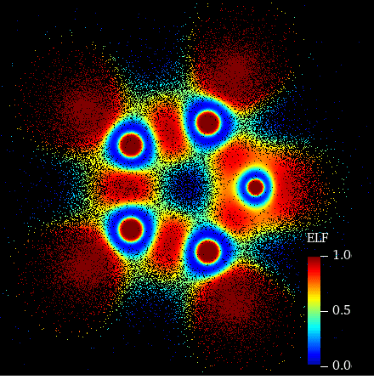
Can two identical particles ever share the same spot in quantum mechanics?
Image: Silvi, CC BY-SA 4.0, via Wikimedia Commons
the Pauli exclusion principle forbids
Can two identical particles ever share the same spot in quantum mechanics?
Imagine you have two identical smartphones, and you want to put them in the same pocket. You quickly realize this isn't possible because you can't fit them both there without them getting squished.
In quantum mechanics, it's like having two identical smartphones trying to fit into the same pocket. They can't both occupy the same space without violating a fundamental rule.
Example
If you try to put two electrons in the same orbital (like trying to fit two smartphones in one pocket), they must have different spins (like having one phone with a case and the other without).
Remember this
The Pauli exclusion principle ensures that no two identical fermions can occupy the same quantum state.
Text adapted from Wikipedia, licensed under CC BY-SA 4.0.
Related concepts
Electron configuration
Why can't two electrons in an atom be identical twins?
Pauli exclusion principle
Why can't two electrons crash into the same spot?
No-cloning theorem
Can you copy a secret recipe perfectly?
Eastin–Knill theorem
No quantum error correcting code can have a continuous symmetry acting transversely on physical qubits
Quantum cellular automaton
Can different systems exhibit the same quantum properties?
Cooper pair
Cooper pairs are bound electrons with opposite spin and momentum
Swipe through 100 ML concepts daily
Open Pocket Polymath