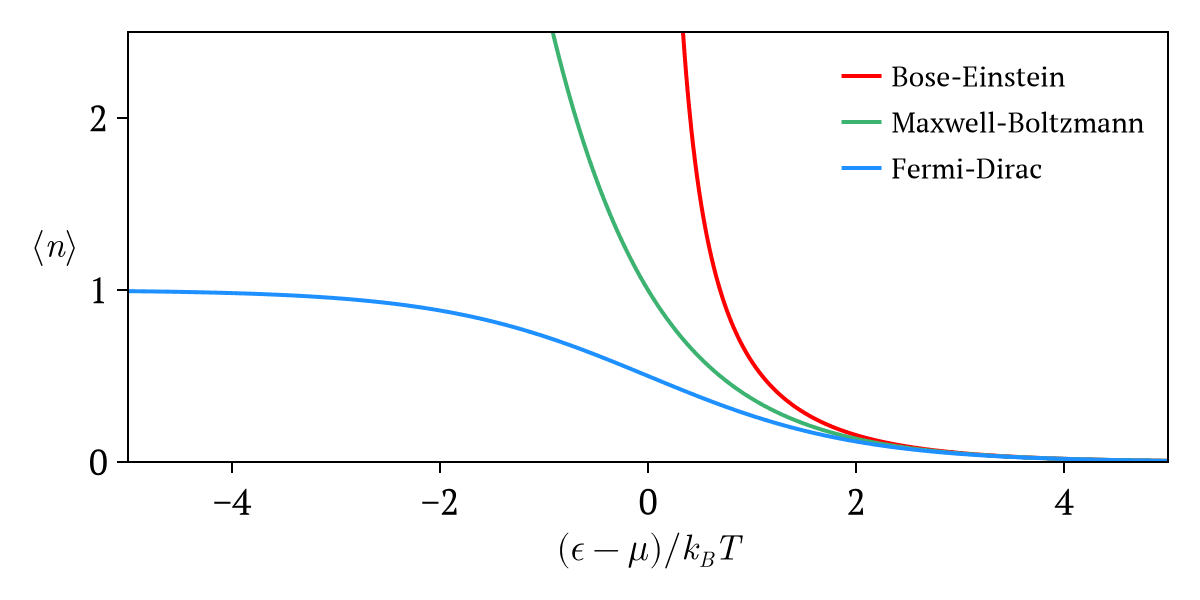
Fermi-Dirac statistics govern fermions' energy distribution
Fermi–Dirac statistics
Fermi-Dirac statistics govern fermions' energy distribution
Fermi-Dirac statistics describe the distribution of fermions over energy states, ensuring no two particles occupy the same state due to the Pauli exclusion principle.
Fermi-Dirac statistics apply to identical particles with half-integer spin, such as electrons, influencing their thermodynamic behavior.
The Fermi-Dirac distribution was independently derived by Enrico Fermi and Paul Dirac in 1926, highlighting its significance in quantum mechanics and statistical mechanics.
Example
Electrons in a metal at absolute zero fill up energy states up to the Fermi energy, leaving no vacancies above it.
Remember this
Understanding Fermi-Dirac statistics is crucial for explaining the behavior of fermions in various physical systems.
Text adapted from Wikipedia, licensed under CC BY-SA 4.0.
Related concepts
Spin–statistics theorem
Spin-statistics theorem links particle spin to statistics
Pauli exclusion principle
Why can't two electrons crash into the same spot?
Maxwell–Boltzmann distribution
Probability of a state with energy E is proportional to e^(-E/kT)
Dirac equation
Dirac equation implies existence of antimatter
the Pauli exclusion principle forbids
Can two identical particles ever share the same spot in quantum mechanics?
Uncertainty principle
Landauer's principle resolves: erasing one bit of information dissipates at least kT ln 2 of energy
Swipe through 100 ML concepts daily
Open Pocket Polymath