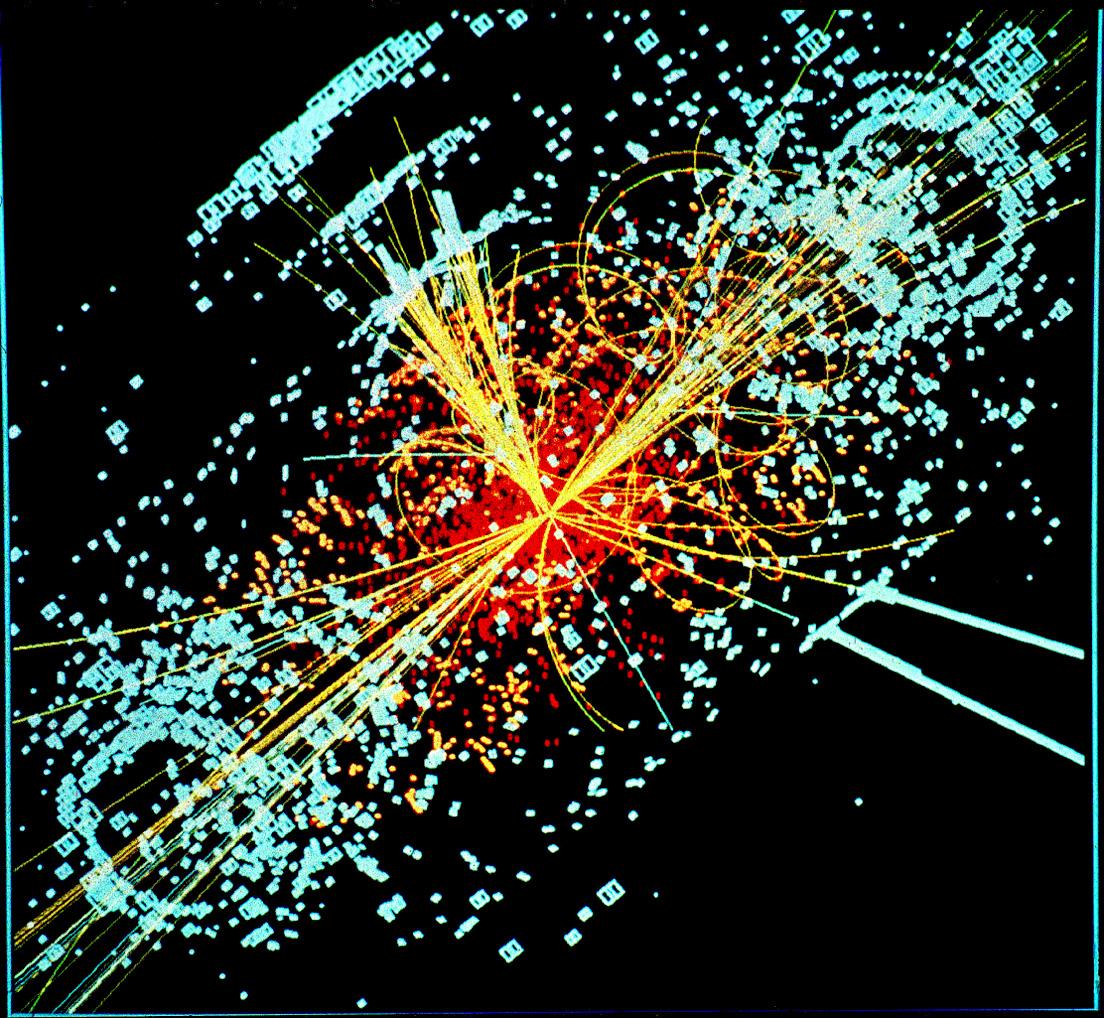
Why do quarks behave differently at high-energy particle collisions?
Asymptotic safety
Why do quarks behave differently at high-energy particle collisions?
Imagine you're at a crowded party, and as you move closer to people, you can hear them better. But as you zoom in with a powerful microscope, you start to notice that the particles you're observing are interacting less with each other.
As quarks get closer together at higher energies, like zooming in on a microscopic party, they start to interact less. This is because their force of attraction weakens as they get closer, making them easier to study.
Example
At lower energies, quarks strongly attract each other, like people at a crowded party. But as you increase the energy, like zooming in with a microscope, the attraction weakens, making the quarks easier to observe.
Remember this
Quarks interact less strongly at higher energies, making them easier to study.
Text adapted from Wikipedia, licensed under CC BY-SA 4.0.
Related concepts
Solitary confinement
Free quarks are never observed; they're always bound in hadrons
Quark
Why can't you see tiny particles called quarks?
QCD (quantum chromodynamics) describes
Why can't you split up the strong force like you split up water?
CP violation
CP violation discovered in 1964 neutral kaon decays
Mathematical formulation of the Standard Model
Ever wondered why particles behave so strangely?
Emergence
Why do simple ingredients create something complex and delicious?
Swipe through 100 ML concepts daily
Open Pocket Polymath