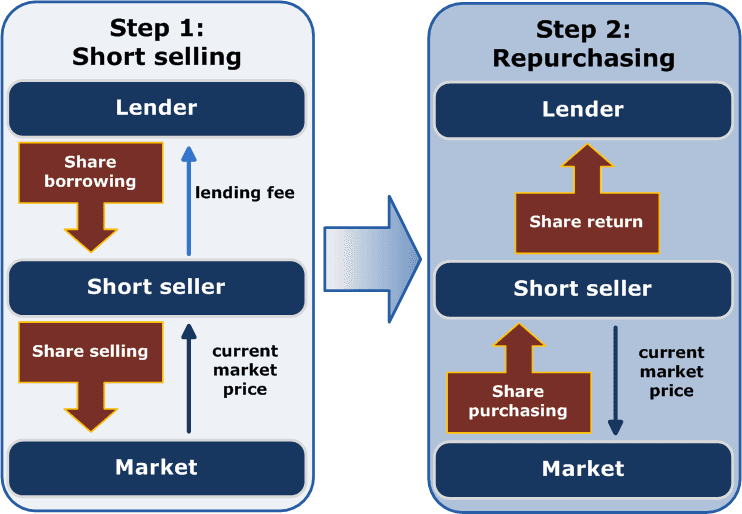
Short selling involves borrowing shares to sell, hoping to buy back cheaper
Short (finance)
Short selling involves borrowing shares to sell, hoping to buy back cheaper
To execute short selling, an investor must borrow shares from a lender and sell them on the market. The investor is obligated to buy back the same number of shares at a later date to return to the lender. If the share price drops, the investor profits from the difference. Conversely, if the price rises, the investor incurs a loss.
Example
An investor borrows 100 shares of Company X, sells them for $50 each, and hopes the price drops to $40. If successful, the investor buys back 100 shares at $40, returns them to the lender, and profits $1,000 ($50 - $40) minus any borrowing fees.
Remember this
Short selling can significantly impact market prices and is a tool for profit in declining markets.
Text adapted from Wikipedia, licensed under CC BY-SA 4.0.
Related concepts
the disposition effect causes
Why do you sometimes regret selling stocks too soon or holding onto losing ones?
Margin Call
Margin call requires additional collateral due to increased credit risk
Anchoring effect
Ever bought a car thinking it's a great deal only to regret it later?
Bid–ask spread
Bid-ask spread measures transaction costs and liquidity
Order (exchange)
Limit orders set a price; market orders execute immediately
Stock
A single share represents fractional ownership of a company
Educational content, not financial advice.
Swipe through 100 ML concepts daily
Open Pocket Polymath