Value at Risk (VaR) estimates potential loss under normal market conditions
Value at risk
Value at Risk (VaR) estimates potential loss under normal market conditions
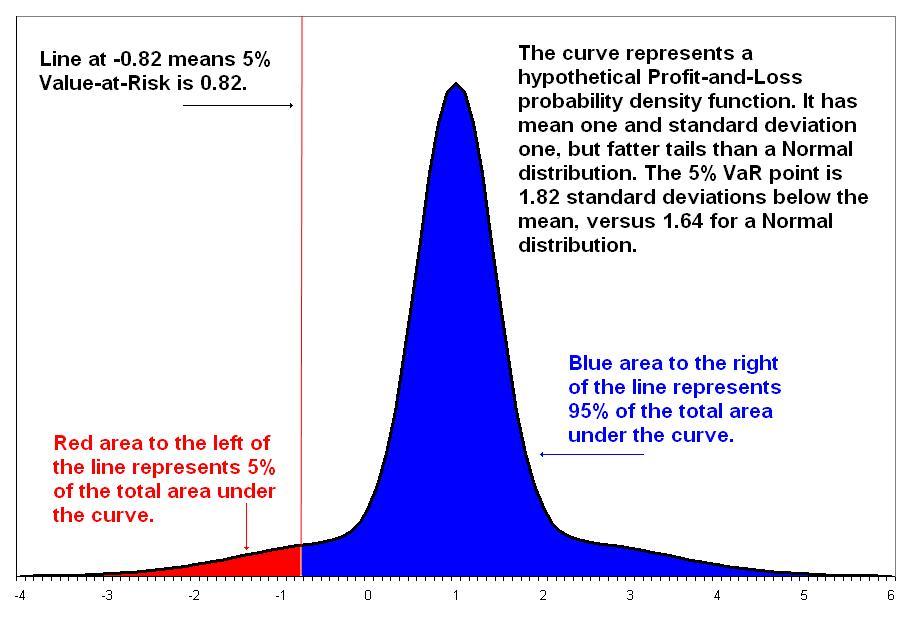
Value at Risk (VaR) is a financial metric used to quantify the potential loss in an investment portfolio over a specified time period, given normal market conditions. It helps firms and regulators understand the amount of assets needed to cover possible losses. VaR is typically expressed as a probability (p) and a time horizon, indicating the maximum loss expected with a certain confidence level.
Example
If a portfolio has a one-day 5% VaR of $1 million, it means there is a 0.05 probability that the portfolio will lose $1 million or more in one day, assuming no trading occurs.
Remember this
Understanding VaR helps financial institutions manage risk and ensure they have sufficient capital to cover potential losses.
Text adapted from Wikipedia, licensed under CC BY-SA 4.0.
Related concepts
Financial risk management
Ever worried about losing more than just your shirt in a bad investment?
Conditional VaR (CVaR) improves
Ever worried about losing more than you planned in a risky investment?
Beta (finance)
Beta measures a stock's volatility relative to the market
VIX
VIX measures 30-day S&P 500 volatility
Deflated Sharpe ratio
DSR penalizes upside volatility as much as downside
Greeks (finance)
Greeks measure sensitivity of option prices to underlying parameters
Educational content, not financial advice.
Swipe through 100 ML concepts daily
Open Pocket Polymath