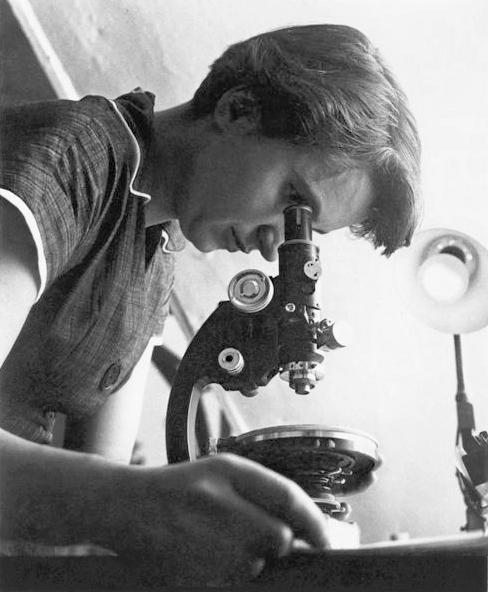
Rosalind Franklin's X-ray diffraction image, known as Photo 51, was critical to discovering the structure of DNA
Rosalind Franklin
Rosalind Franklin's X-ray diffraction image, known as Photo 51, was critical to discovering the structure of DNA
Rosalind Franklin's work was central to understanding the molecular structures of DNA. Her X-ray diffraction image, known as Photo 51, played a crucial role in the discovery of DNA's double helix structure. Franklin's contributions were largely unrecognized during her lifetime.
Franklin's Photo 51 provided essential data that helped James Watson and Francis Crick deduce the double helix structure of DNA. This image was a turning point in molecular biology, leading to a deeper understanding of genetic material.
Despite her significant contributions, Franklin did not receive the recognition she deserved during her lifetime. Her work has since been acknowledged as pivotal in the discovery of DNA's structure, highlighting the importance of her contributions to science.
Remember this
Rosalind Franklin's Photo 51 was a turning point in understanding DNA's structure, demonstrating the critical nature of her work in molecular biology.
Text adapted from Wikipedia, licensed under CC BY-SA 4.0.
Related concepts
Molecular Structure of Nucleic Acids: A Structure for Deoxyribose Nucleic Acid
Can DNA's secret be unlocked by its shape?
Barbara McClintock
Barbara McClintock discovered transposons in maize
Francis Crick
Did you know DNA holds life's blueprint?
Erwin Chargaff
Did you know DNA's structure was a mystery solved by Chargaff's rules?
Plant cell
Why do plants look green?
Henrietta Swan Leavitt
Henrietta Leavitt discovered the period-luminosity relation of Cepheid variables
Swipe through 100 ML concepts daily
Open Pocket Polymath