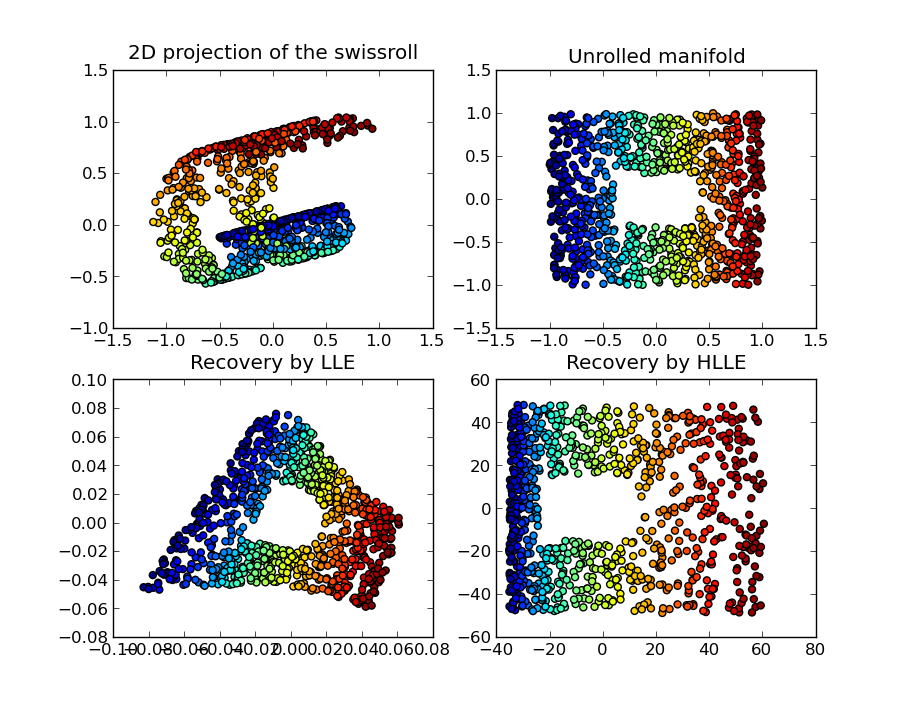
Ever wondered how computers quickly understand vast amounts of text?
Image: Olivier Grisel, CC BY 3.0, via Wikimedia Commons
Random projection
Ever wondered how computers quickly understand vast amounts of text?
Imagine you have a huge library of books and you want to find a specific quote without reading every single one.
Think of random projection as a magic trick that helps computers quickly find the quote by creating a simpler, shorter list that still has all the important information.
Example
If the original quote list had 1,000 quotes and random projection reduces it to 100, the computer can still find the quote much faster.
Remember this
Random projection helps computers quickly process and find information in large datasets.
Text adapted from Wikipedia, licensed under CC BY-SA 4.0.
Related concepts
the Johnson-Lindenstrauss lemma says
Can we shrink big data without losing important details?
Tensor network
Ever wondered how scientists manage massive data without endless storage?
List of unsolved problems in mathematics
Why do random points in high dimensions seem to be evenly spaced?
Large language model
LLMs can generate, summarize, translate, and analyze text in many contexts
Randomized algorithm
Randomized algorithms use random bits for expected polynomial time
General-purpose computing on graphics processing units
Did you know your computer can do more than just compute numbers?
Swipe through more Machine Learning concepts
Open Pocket Polymath