Can we shrink big data without losing important details?
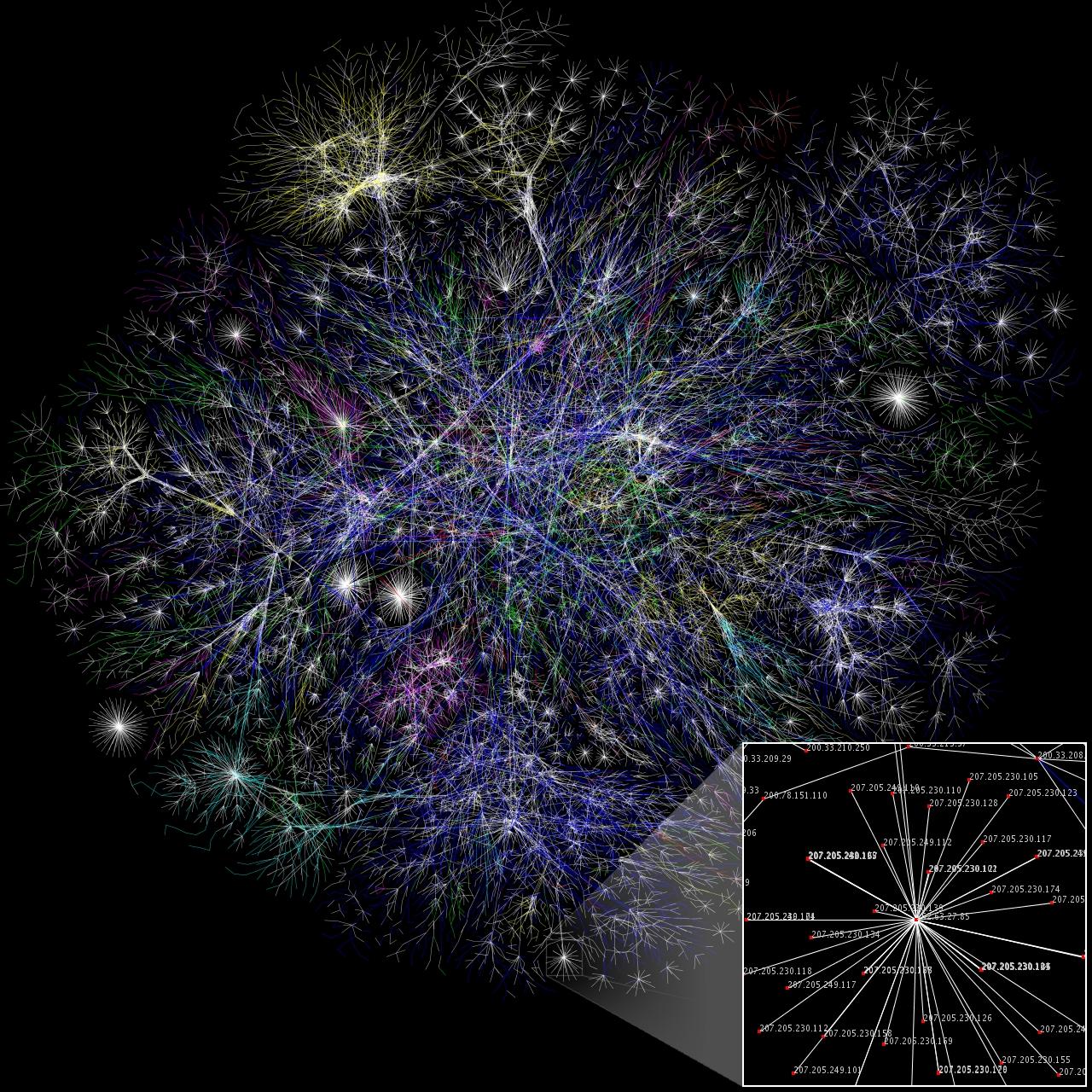
Image: The Opte Project, CC BY 2.5, via Wikimedia Commons
the Johnson-Lindenstrauss lemma says
Can we shrink big data without losing important details?
Imagine you're trying to fit a huge family photo onto a small frame without cutting anyone off or making them look squished. You want to keep everyone recognizable and preserve the relationships between them.
Think of random projection as a magic trick that squishes a huge photo onto a smaller frame while keeping everyone's faces and relationships intact. It's like finding a new, smaller space where the photo fits perfectly without losing any important details.
Example
You have a photo with 100 people (points) in a 10x10 grid (dimensional space). Using random projection, you can reduce this to a 2x2 grid (dimensional space) while keeping the distances between people (relationships) almost the same.
Remember this
Random projection allows you to simplify complex information without losing the essence of the relationships within it.
Text adapted from Wikipedia, licensed under CC BY-SA 4.0.
Related concepts
random projection to O(log n/ε²) dimensions preserves pairwise distances within 1±ε
Can you shrink a 3D object into 2D without losing its shape?
t-SNE preserves local structure
Can we see the hidden patterns in a cloud of data points?
batch size affects generalization: larger batches find sharper minima
Larger batch sizes lead to sharper minima, enhancing generalization by providing more accurate gradient estimates
List of unsolved problems in mathematics
Why do random points in high dimensions seem to be evenly spaced?
Vector quantization
How can you store a huge library of books in a tiny closet?
the curse of dimensionality makes nearest neighbor search unreliable
Why can't we find our friends easily as we move to a city with more and more neighborhoods?
Swipe through 100 ML concepts daily
Open Pocket Polymath