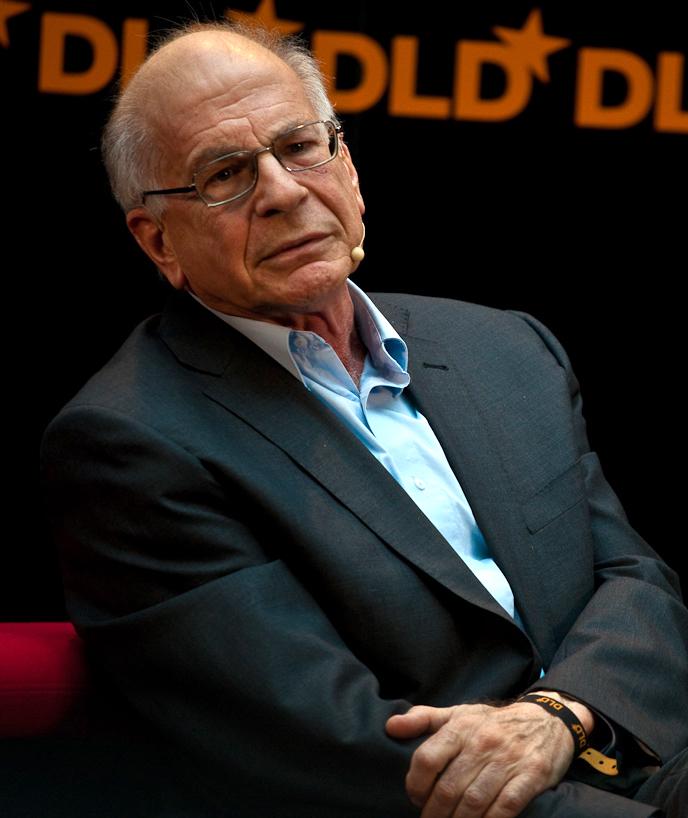
Daniel Kahneman and Amos Tversky developed Prospect Theory in 1979
Prospect theory
Daniel Kahneman and Amos Tversky developed Prospect Theory in 1979
The theory introduces a value function defined over gains and losses, rather than final wealth. It also includes a probability-weighting function that reflects the tendency of individuals to overweight small probabilities and underweight large ones. This challenges the expected utility theory, which assumes perfectly rational agents.
Example
A person might prefer a guaranteed $50 over a 50% chance to win $100, even though the expected value of the gamble is higher.
Remember this
Understanding Prospect Theory helps explain why people make irrational decisions when faced with risk.
Text adapted from Wikipedia, licensed under CC BY-SA 4.0.
Related concepts
List of cognitive biases
Why do you choose a smaller reward now over a bigger one later?
Decision-making
Does how you frame choices change your decisions?
Real options valuation
Why can't we always predict the future in business?
Markowitz model
Harry Markowitz introduced the mean-variance optimization model in 1952
Recency bias
Recency bias overvalues recent events in decision-making
Risk parity
Risk parity allocates based on risk contribution, not capital allocation
Educational content, not financial advice.
Swipe through 100 ML concepts daily
Open Pocket Polymath