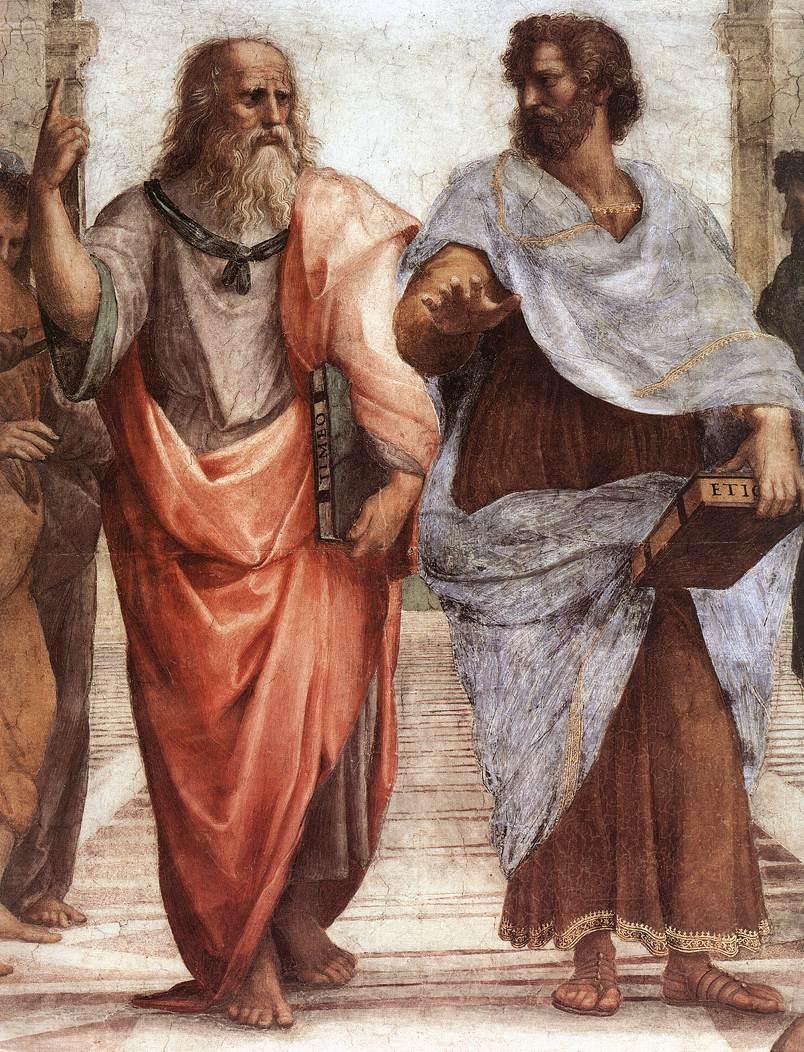
Can machines ever truly think like humans?
Image: Raphael, Public domain, via Wikimedia Commons
Philosophy of artificial intelligence
Can machines ever truly think like humans?
Imagine you're playing chess with a friend. You both make moves, trying to predict each other's strategy. Now, imagine if your chess partner was a computer. Would it be able to think and predict like a human?
Gödel's incompleteness theorems suggest that even if a computer (or any sufficiently powerful formal system) could play chess perfectly, it might still not be able to understand the game in the same way humans do. It could follow rules perfectly but might lack the deeper understanding or creativity that comes with human thought.
Example
A computer chess program can beat chess grandmasters by calculating millions of possible moves faster than a human can. However, it doesn't "understand" chess the way a human does; it just follows programmed algorithms.
Remember this
Gödel's incompleteness theorems imply that no matter how advanced a computer gets, there will always be some aspects of human-like understanding and creativity that it cannot replicate.
Text adapted from Wikipedia, licensed under CC BY-SA 4.0.
Related concepts
Rule of inference
Can a mathematician prove everything in logic?
Gödel's incompleteness theorems
Can a puzzle have missing pieces we can't see?
Foundations of mathematics
Can math ever be truly complete and consistent?
Proof of impossibility
Can a perfect square root be neatly packaged as a simple fraction?
Proof sketch for Gödel's first incompleteness theorem
Can a computer always decide if a program will finish running?
Theory of computation
Can a machine think like a human?
Swipe through more Philosophy concepts
Open Pocket Polymath