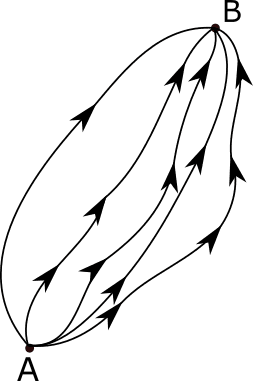
Feynman showed a particle takes all possible paths simultaneously
Path integral formulation
Feynman showed a particle takes all possible paths simultaneously
The path integral formulation in quantum mechanics replaces the classical idea of a single trajectory with a sum over all possible quantum trajectories. This approach allows for a more comprehensive understanding of quantum systems by considering every potential path a particle can take.
The path integral formulation is crucial for achieving manifest Lorentz covariance, making it easier to work with compared to other methods like canonical quantization. This feature simplifies the process of dealing with different canonical descriptions of the same quantum system.
Additionally, the path integral formulation is often simpler to use when guessing the correct form of the Lagrangian for a theory. The Lagrangian naturally enters the path integrals, making it easier to work with than the Hamiltonian.
Example
Consider a particle moving from point A to point B. In classical mechanics, we would calculate the path taken by the particle based on the principle of stationary action. In quantum mechanics, using the path integral formulation, we consider all possible paths the particle could take between A and B and sum their contributions to find the quantum amplitude.
Remember this
Understanding the path integral formulation is essential for advancing theoretical physics and simplifying calculations involving quantum systems.
Text adapted from Wikipedia, licensed under CC BY-SA 4.0.
Related concepts
Feynman diagram
Feynman diagrams revolutionized theoretical physics
Erwin Schrödinger
Can light be both a wave and a particle?
History of physics
Did Dirac's math hint at a shadowy twin of electrons?
Uncertainty principle
Landauer's principle resolves: erasing one bit of information dissipates at least kT ln 2 of energy
Mathematical formulation of the Standard Model
Ever wondered why particles behave so strangely?
Asymptotic safety
Why do quarks behave differently at high-energy particle collisions?
Swipe through 100 ML concepts daily
Open Pocket Polymath