Kelly criterion formula: bet f* = (bp - q)/b
Kelly criterion
Kelly criterion formula: bet f* = (bp - q)/b
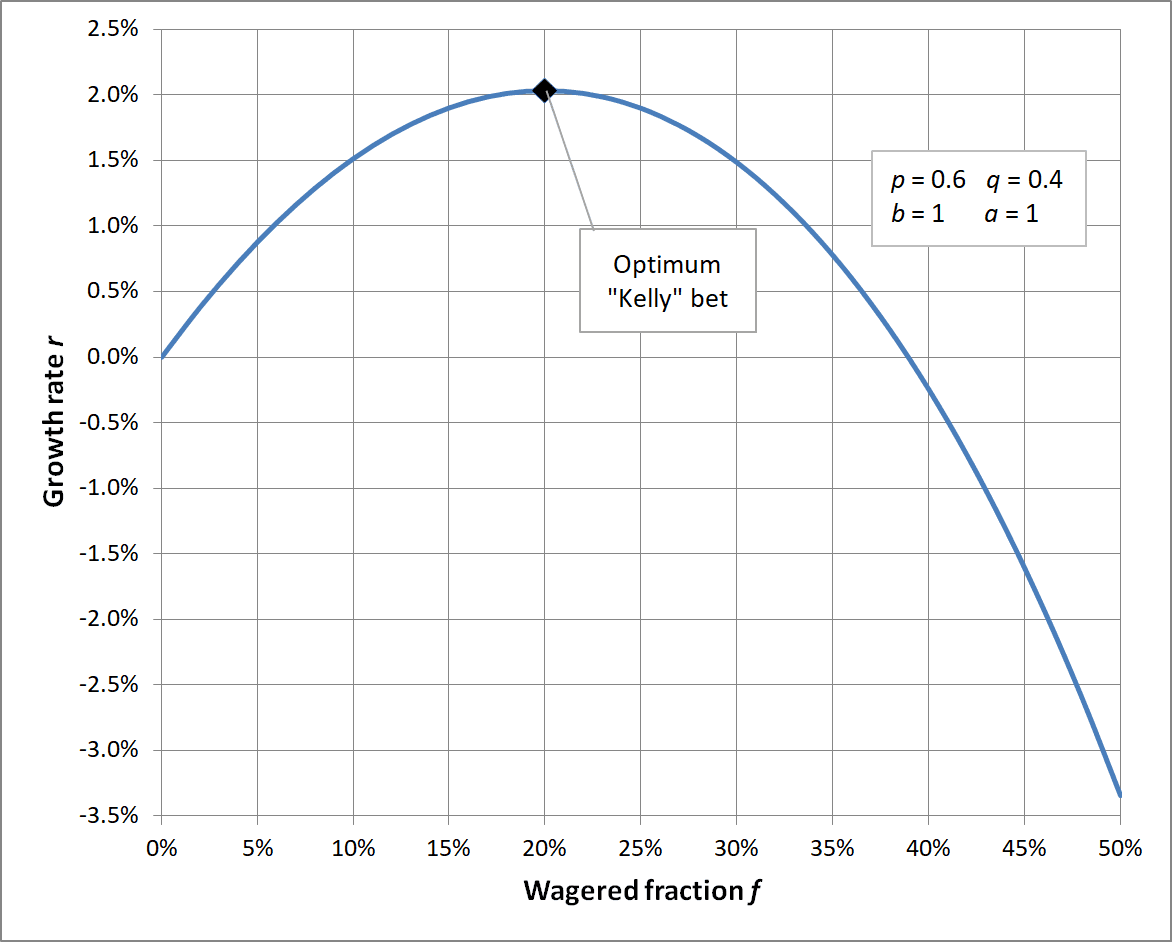
The Kelly criterion is a formula used for risk allocation in betting and investing. It aims to maximize the long-term expected value of the logarithm of wealth, which equates to maximizing the long-term expected geometric growth rate of wealth.
Example
If you bet $100 with odds of 2 (b=2) and the probability of winning (p) is 0.6, the Kelly bet size (f*) would be calculated as (2*0.6 - 0.4)/2 = 0.2. Thus, you would bet 20% of your bankroll.
Remember this
Understanding the Kelly criterion helps investors and gamblers optimize their bets and investments for maximum long-term growth.
Text adapted from Wikipedia, licensed under CC BY-SA 4.0.
Related concepts
Quantity theory of money
MV = PY equation
the Capital Asset Pricing Model (CAPM) says
Ever wondered why some investments seem riskier than others?
the Black-Scholes formula prices
How do you price a gamble on a stock's future price?
Prediction market
Why does betting on the future cost more to place than to take?
Risk premium
Why do some investments pay more than others?
Value at risk
Value at Risk (VaR) estimates potential loss under normal market conditions
Educational content, not financial advice.
Swipe through 100 ML concepts daily
Open Pocket Polymath