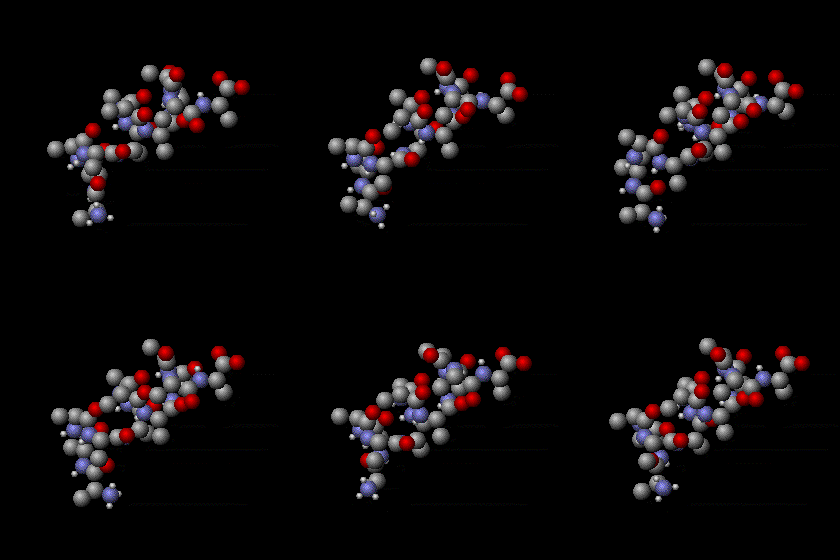
Equipartition theorem: Each degree of freedom contributes ½kT of energy at thermal equilibrium
Equipartition theorem
Equipartition theorem: Each degree of freedom contributes ½kT of energy at thermal equilibrium
The equipartition theorem is a fundamental principle in classical statistical mechanics that quantifies the relationship between temperature and energy distribution in a system. It asserts that energy is equally distributed among all degrees of freedom, ensuring that each contributes ½kT to the system's total energy at thermal equilibrium. This concept is crucial for understanding how energy is partitioned in different forms, such as kinetic and potential energy.
Example
In a monatomic ideal gas, each atom contributes ½kT of energy to its kinetic motion, where k is the Boltzmann constant and T is the temperature. This means that the total average kinetic energy per atom is 3/2kT, reflecting the equipartition theorem's prediction for translational motion.
Remember this
Understanding the equipartition theorem is essential for predicting the average energy contributions of different degrees of freedom in a system, which is fundamental for calculating heat capacities and analyzing thermodynamic properties.
Text adapted from Wikipedia, licensed under CC BY-SA 4.0.
Related concepts
Second law of thermodynamics
Entropy of isolated systems never decreases
Uncertainty principle
Landauer's principle resolves: erasing one bit of information dissipates at least kT ln 2 of energy
Maxwell–Boltzmann distribution
Probability of a state with energy E is proportional to e^(-E/kT)
Noether's theorem
Noether's theorem links continuous symmetries to conservation laws
Mass–energy equivalence
E=mc²
Mathematical formulation of the Standard Model
Ever wondered why particles behave so strangely?
Swipe through 100 ML concepts daily
Open Pocket Polymath