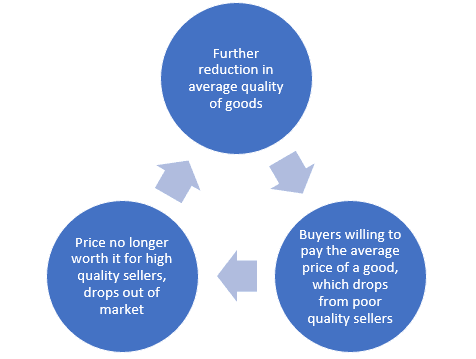
Adverse selection occurs when one party has more information than the other
Adverse selection
Adverse selection occurs when one party has more information than the other
Adverse selection arises from asymmetric information in markets, leading to unfair advantages for one party. This imbalance can cause the uninformed party to avoid transactions or demand skewed prices, ultimately harming market efficiency. Asymmetric information distorts the market's ability to reflect true value and quality.
Example
In the used car market, sellers may hide defects, leading buyers to fear unfair deals and withdraw from the market.
Remember this
Understanding adverse selection helps in designing mechanisms to mitigate information asymmetry and promote fairer market transactions.
Text adapted from Wikipedia, licensed under CC BY-SA 4.0.
Related concepts
Information asymmetry
Why do you bet less on a coin flip after winning big?
Moral hazard
Moral hazard occurs when an economic actor takes on more risk because it won't bear the full costs
Systematic
Systematic risk affects the entire market
Status quo bias
Why do we stick to the default option even when it's not the best choice?
Decision-making
Does how you frame choices change your decisions?
Recency bias
Recency bias overvalues recent events in decision-making
Educational content, not financial advice.
Swipe through 100 ML concepts daily
Open Pocket Polymath