What happens to a variable when you call a function twice without resetting it?
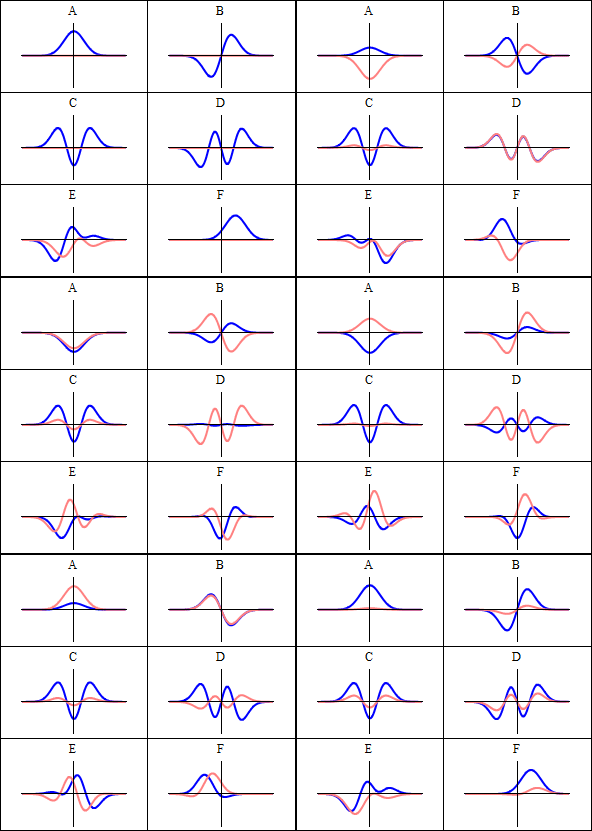
Wave function
What happens to a variable when you call a function twice without resetting it?
Imagine you're counting apples in a basket. You start with 5 apples and add 3 more apples after a while. How many apples do you have now?
If you start with 5 apples and add 3 more, you end up with 8 apples. In programming, if a variable 'x' is initialized to 5 and then you add 3 to it without resetting 'x', it will show the new total of 8.
Example
x = 5; x = x + 3; x now equals 8.
Remember this
A variable retains its updated value after subsequent operations unless explicitly reset.
Text adapted from Wikipedia, licensed under CC BY-SA 4.0.
Related concepts
Glossary of engineering: M–Z
Can calculus functions flip between smooth and abrupt?
Constructive set theory
Why can't you always find the smallest number in a list?
Gibbs phenomenon
Why does a Fourier series overshoot at sharp edges?
Sturm's theorem
Can you always split a polynomial into simpler pieces to find its roots?
Uniform convergence
Ever wondered why some infinite sums add up nicely while others don't?
History of science
How can a particle be in two places at once?
Swipe through 100 ML concepts daily
Open Pocket Polymath