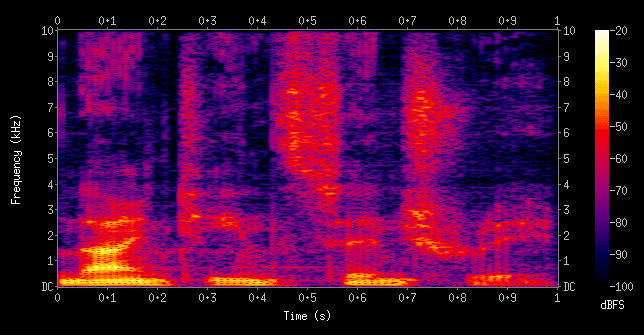
STFT divides a signal into shorter segments for analysis
Short-time Fourier transform
STFT divides a signal into shorter segments for analysis
The short-time Fourier transform (STFT) analyzes a signal by dividing it into shorter segments, allowing for the examination of its frequency content over time. This method provides a detailed view of how the signal's frequency spectrum changes, which is crucial for understanding non-stationary signals.
Example
Consider a signal composed of a 440 Hz tone that gradually shifts to 880 Hz over 5 seconds. Using STFT, the signal is divided into 1-second segments. The Fourier transform is computed for each segment, revealing the frequency content at each time point.
Remember this
STFT is essential for analyzing signals with time-varying frequency content, such as audio signals or communications signals.
Text adapted from Wikipedia, licensed under CC BY-SA 4.0.
Related concepts
Glossary of engineering: A–L
Can you hear colors?
wavelets provide over Fourier: both time and frequency localization
Wavelets provide both time and frequency localization, unlike Fourier transforms which offer only frequency localization
Wavelet transform
Ever wondered why some sounds change pitch while others stay constant?
Periodic function
How can we break down repeating patterns into simpler parts?
sinusoidal position encoding works: each dimension has a different frequency
Sinusoidal position encoding assigns unique frequencies to each dimension, enabling the model to distinguish positions effectively
Singular value decomposition
Ever wondered how to compress images without losing quality?
Swipe through 100 ML concepts daily
Open Pocket Polymath