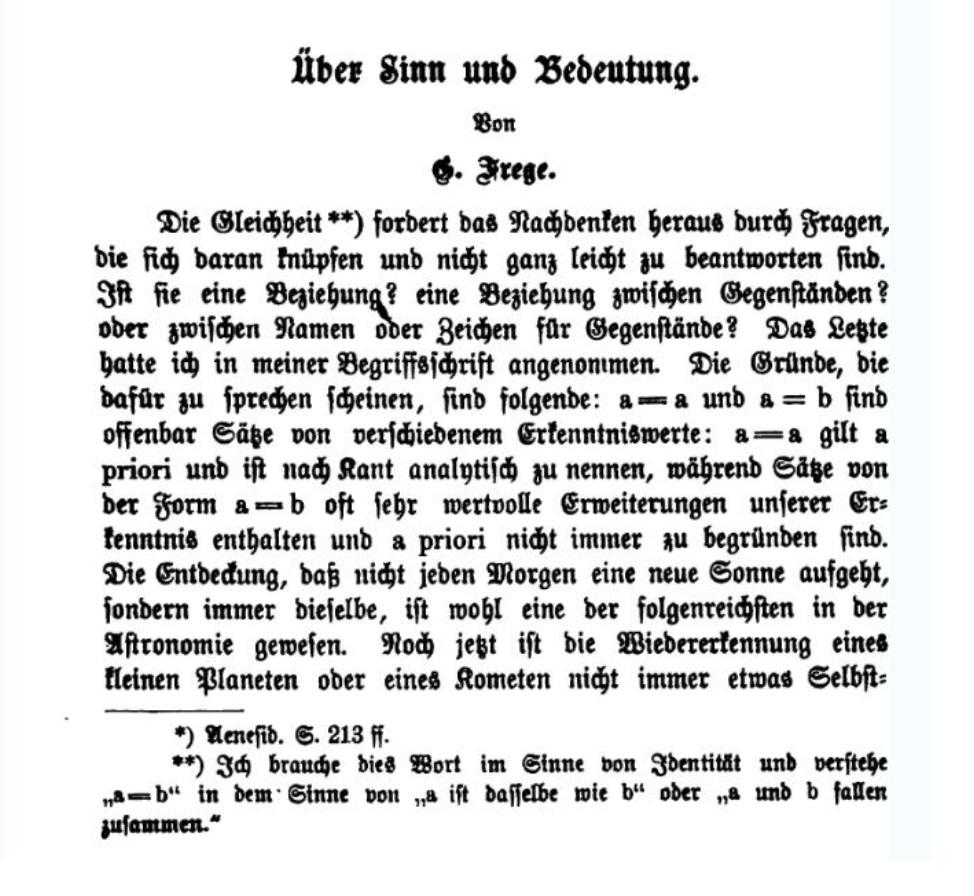
Frege's distinction between sense and reference
Sense and reference
Frege's distinction between sense and reference
Frege's theory differentiates between the meaning a term expresses (sense) and the object it refers to (reference). He posits that even if 'morning star' and 'evening star' refer to the same object (Venus), they have different senses because they express different thoughts.
Example
'Morning star' and 'evening star' both refer to Venus, but they convey different information: 'morning star' refers to Venus as seen in the morning, while 'evening star' refers to Venus as seen in the evening.
Remember this
Understanding this distinction helps clarify how language can convey different meanings even when referring to the same object.
Text adapted from Wikipedia, licensed under CC BY-SA 4.0.
Related concepts
Wittgenstein's later philosophy argues
Can words mean different things depending on how we use them?
The Real
How can a word mean different things over time?
Edmund Husserl
Can you see colors without knowing what they mean?
Theory of descriptions
Russell's theory of descriptions explains meaningful but false statements
Falsifiability
Popper introduced falsifiability as a criterion for scientific theories
Four-dimensionalism
Objects persist by having temporal parts
Swipe through 100 ML concepts daily
Open Pocket Polymath