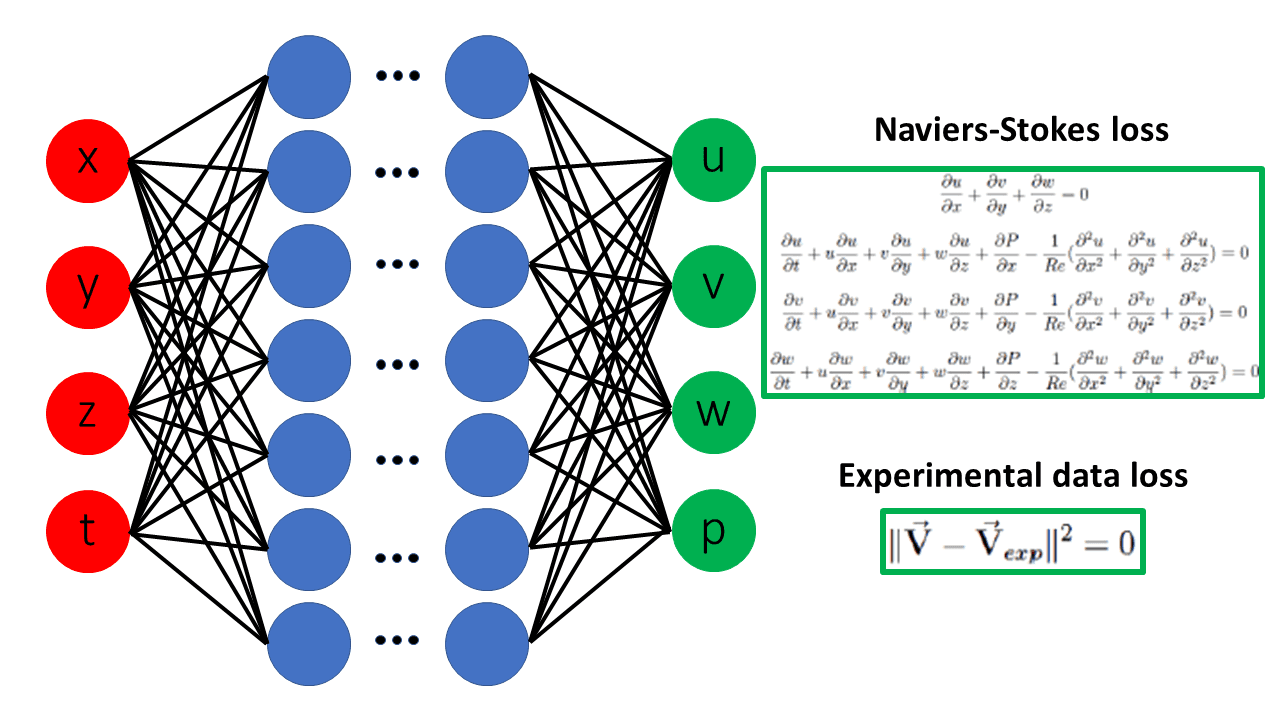
Neural ODEs model continuous-time dynamics with a neural network as the derivative
Physics-informed neural networks
Neural ODEs model continuous-time dynamics with a neural network as the derivative
Neural ODEs are a type of universal function approximator that can embed the knowledge of any physical laws governing a given data-set in the learning process. They are described by partial differential equations (PDEs) and can be categorized as neural fields due to their ability to process continuous spatial and time coordinates and output continuous PDE solutions.
Example
In a neural ODE framework, a neural network is trained to approximate the derivative of a system's state with respect to time, effectively learning the continuous-time dynamics of the system.
Remember this
Understanding neural ODEs is crucial for enhancing the information content of limited data and improving the generalizability of machine learning models in applications with low data availability.
Text adapted from Wikipedia, licensed under CC BY-SA 4.0.
Related concepts
Glossary of artificial intelligence
Can computers learn to mimic human brain functions?
Neural network (machine learning)
Ever tried adjusting the learning rate like tuning a musical instrument?
ill-conditioned matrices cause numerical instability: small input changes → large output changes
Small changes can lead to huge errors in math
Adam combines momentum and RMSprop: adapts per-parameter learning rates
Ever wondered how a car adjusts its speed for smooth turns?
Lyapunov exponents measure: rate of divergence of nearby trajectories in a dynamical system
How do tiny differences grow over time in chaotic systems?
Recurrent neural network
Ever wondered how your phone remembers your voice commands even after months of use?
Swipe through 100 ML concepts daily
Open Pocket Polymath