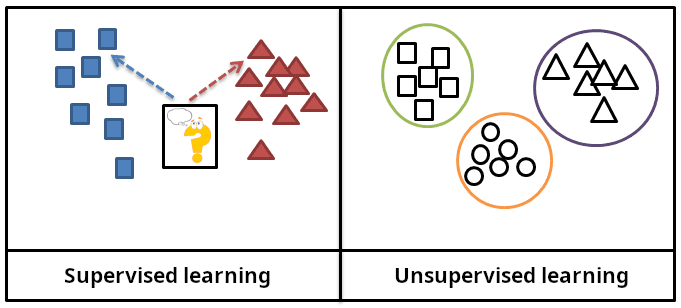
Ever wondered how to figure out the different groups within a mixed-up pile of fruit?
Image: Balkiss.hamad, CC BY-SA 4.0, via Wikimedia Commons
Mixture model
Ever wondered how to figure out the different groups within a mixed-up pile of fruit?
Imagine you're at a fruit market with a mixed bag of apples, oranges, and bananas. You want to sort them into their respective groups without knowing which fruit is which at first.
Think of the mixed bag as a puzzle where each piece belongs to a different group. The idea is to find patterns that help us guess which fruit is which based on how they look together.
Example
You notice that apples tend to be round, oranges are usually round and orange, and bananas are long and curved. By looking at the shapes and colors, you start to sort them into groups.
Remember this
A Gaussian Mixture Model helps us sort mixed data into groups by assuming each group follows a different pattern, like the shapes of fruits.
Text adapted from Wikipedia, licensed under CC BY-SA 4.0.
Related concepts
the multivariate Gaussian is parameterized by: mean vector μ and covariance matrix Σ
Ever wondered how weather patterns or stock market trends can be predicted with surprising accuracy?
Robust statistics
How can we estimate the center and spread of data even when it's messy?
Markov chain Monte Carlo
MCMC samples from complex posterior distributions
convolution (f * g)(t) = ∫f(τ)g(t-τ)dτ
How do different shapes combine to create new patterns?
Gibbs sampling
Gibbs sampling samples each variable conditioned on all others
batch size affects generalization: larger batches find sharper minima
Larger batch sizes lead to sharper minima, enhancing generalization by providing more accurate gradient estimates
Swipe through more Machine Learning concepts
Open Pocket Polymath