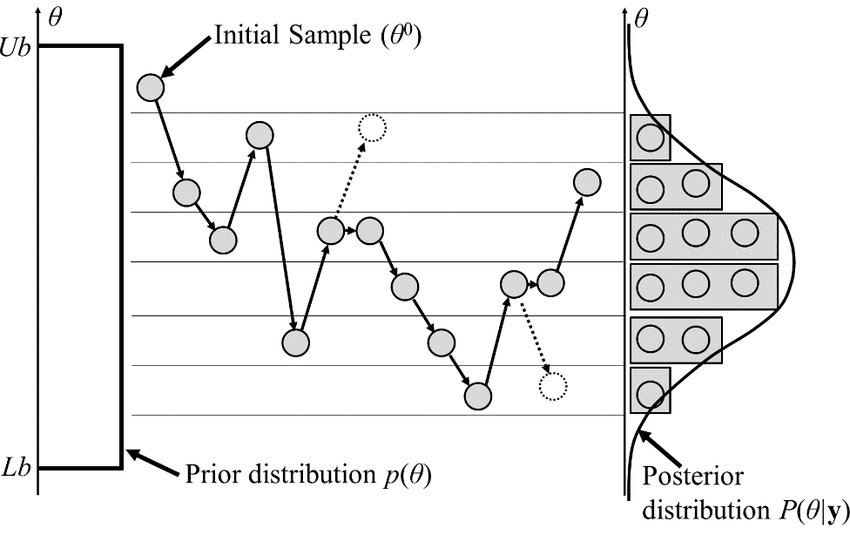
Metropolis-Hastings algorithm samples from difficult distributions
Metropolis–Hastings algorithm
Metropolis-Hastings algorithm samples from difficult distributions
The Metropolis-Hastings algorithm is a Markov chain Monte Carlo (MCMC) method used for obtaining random samples from complex probability distributions. It works by proposing new samples based on previous ones and then deciding whether to accept or reject them based on the probability distribution's value at that point.
The algorithm generates a sequence of samples that can be used to approximate the target distribution or compute integrals like expected values. This makes it particularly useful for high-dimensional distributions where direct sampling is challenging.
While Metropolis-Hastings is powerful for multi-dimensional distributions, single-dimensional distributions often benefit from simpler methods like adaptive rejection sampling, which avoids autocorrelation issues inherent in MCMC methods.
Example
Suppose we want to sample from a target distribution with a high-dimensional space. We start with an initial sample and propose a new sample. If the proposed sample has a higher probability under the target distribution, it is accepted; otherwise, it is rejected. This process continues, building a sequence of samples that approximates the target distribution.
Remember this
Understanding the Metropolis-Hastings algorithm is crucial for researchers dealing with complex, high-dimensional probability distributions where direct sampling is impractical.
Text adapted from Wikipedia, licensed under CC BY-SA 4.0.
Related concepts
Markov chain Monte Carlo
MCMC samples from complex posterior distributions
the Dirichlet distribution does: distribution over probability simplices
How do we predict the likelihood of various outcomes in uncertain situations?
importance sampling does: reweights samples from proposal to estimate target expectation
Why can't we always use the same samples to figure out what's happening in a complex system?
the reverse process learns: p_θ(x_{t-1}|x_t)
Can we trace back the roots of life?
Fisher information
Fisher information measures information about unknown parameters
Langevin dynamics does: adds noise to gradient descent to sample from a distribution
How can we simulate randomness in physics?
Swipe through 100 ML concepts daily
Open Pocket Polymath