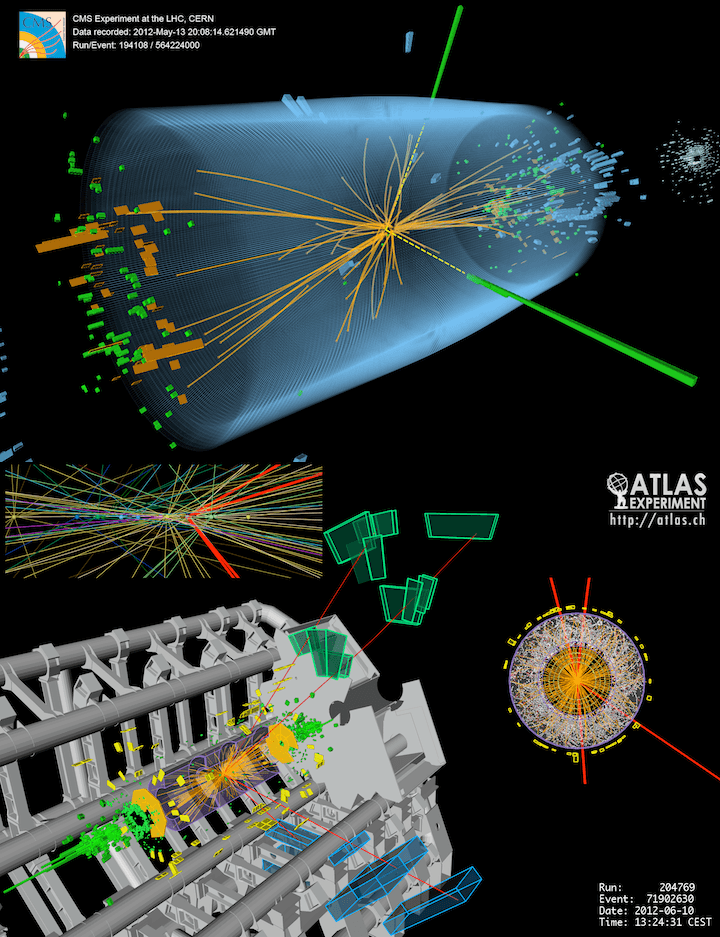
Higgs field permeates all space, giving mass to particles
Higgs boson
Higgs field permeates all space, giving mass to particles
The Higgs boson, an elementary particle produced by the quantum excitation of the Higgs field, decays almost immediately upon generation. Its properties include being a massive scalar boson with zero spin, even parity, no electric or color charge. The Higgs field's interaction with particles gives them mass, making it a crucial component of the Standard Model.
Remember this
Understanding the Higgs field and its role in giving mass to particles is fundamental to particle physics and helps explain the behavior of elementary particles.
Text adapted from Wikipedia, licensed under CC BY-SA 4.0.
Related concepts
Higgs mechanism
W and Z bosons have masses around 80 GeV/c²
Nobel Prize in Physics controversies
Did you know a tiny particle holds the universe's secret?
Emergence
Why do simple ingredients create something complex and delicious?
Gauge theory
Gauge theories are invariant under local transformations
Physics beyond the Standard Model
Could the universe be hiding clues about its deepest secrets?
Renormalization group
Renormalization group (RG) explains physics changes with observation scale
Swipe through 100 ML concepts daily
Open Pocket Polymath