Why does a straight-line guess fail in complex terrain?
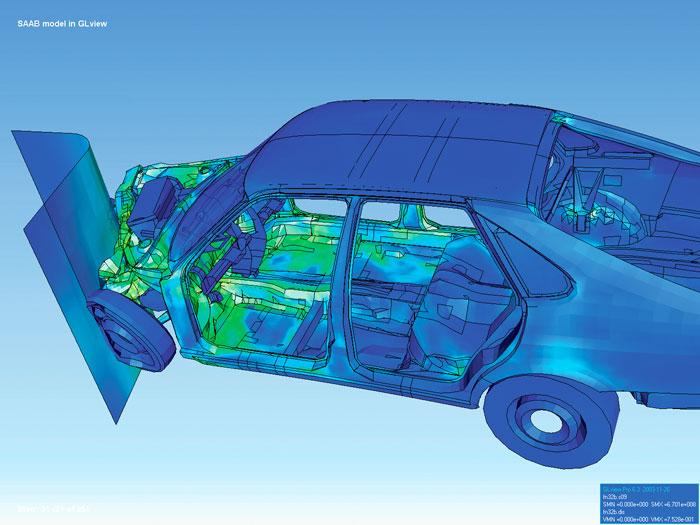
Finite element method
Why does a straight-line guess fail in complex terrain?
Imagine you're hiking and want to predict where you'll end up after a certain distance, but the terrain is full of twists and turns.
A straight-line guess (Euler method) oversimplifies the path, missing the terrain's nuances. The Runge-Kutta method uses intermediate steps (k₁,k₂,k₃,k₄) to better approximate the hiker's true path through complex terrain.
Example
If you guess the hiker's position after 1 km using a straight-line path, it might be off by 100 meters. Runge-Kutta would consider the terrain's ups and downs at smaller intervals, reducing the error.
Remember this
Runge-Kutta method reduces prediction error by considering multiple points along the path, not just the start and end.
Text adapted from Wikipedia, licensed under CC BY-SA 4.0.
Related concepts
non-convex loss landscapes are hard: many local minima and saddle points
Why do some hills have more tricky paths than others?
Linear multistep method
Why does skipping steps save time but lose accuracy?
Ordinary least squares
OLS minimizes squared differences
t-SNE preserves local structure
Can we see the hidden patterns in a cloud of data points?
AdaGrad's learning rate decays to zero
Why does a car's speed drop when it goes uphill?
saddle points are more common than local minima in high dimensions
Why do some mountains have flat tops instead of peaks or valleys?
Swipe through 100 ML concepts daily
Open Pocket Polymath