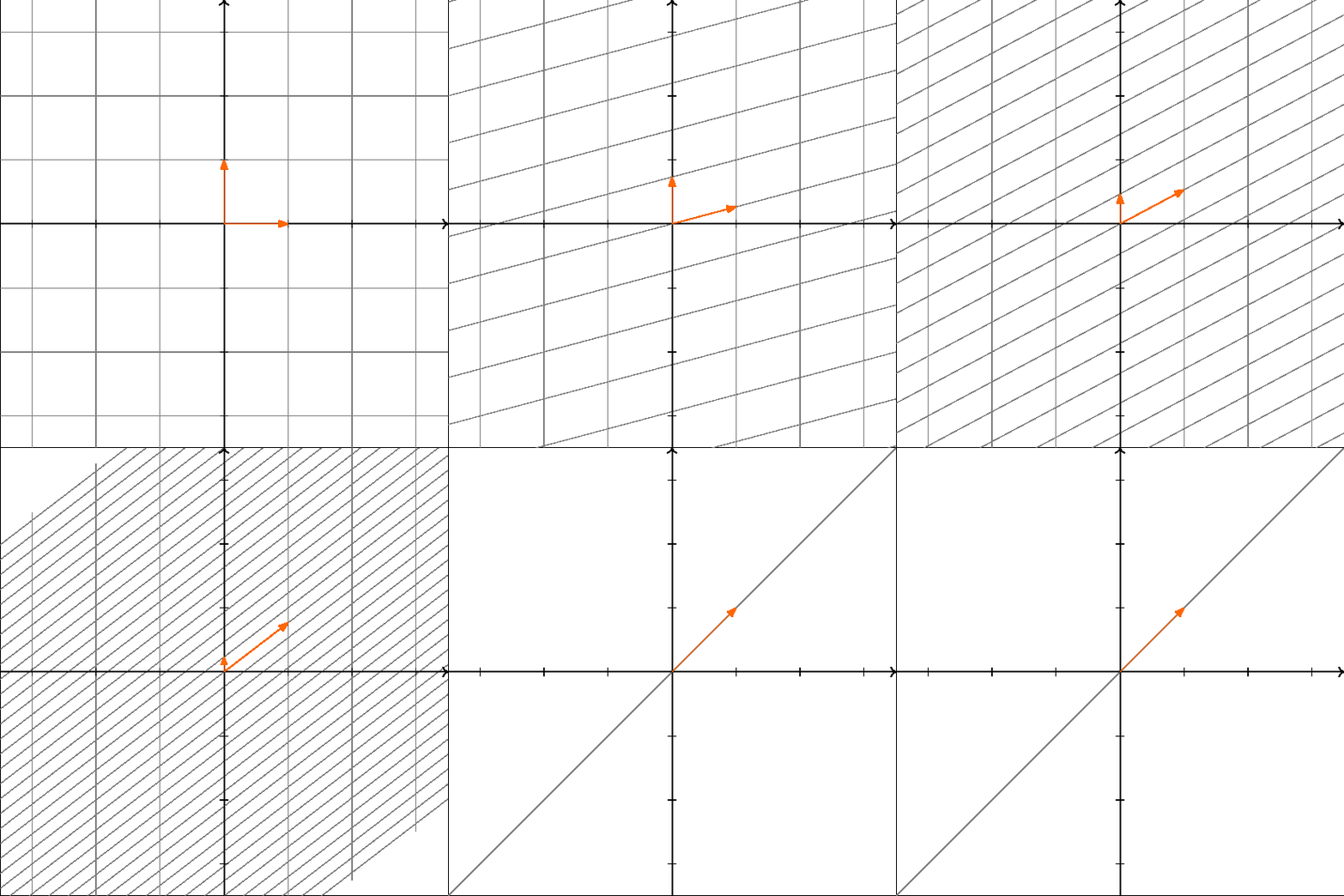
How can we understand complex data with fewer variables?
Image: GruenerBogen, CC BY-SA 4.0, via Wikimedia Commons
Factor analysis
How can we understand complex data with fewer variables?
Imagine you're trying to summarize the taste preferences of a large group of people by asking them to rate a variety of flavors. You have scores for hundreds of different flavors, but you're looking for a simpler way to describe the group's preferences.
Think of it like finding the main ingredients in a recipe that most flavors share. Instead of listing every single flavor, you identify a few key ones that capture the essence of the group's taste preferences.
Example
If you find that most flavors rated highly by the group share common ingredients like sweetness or spiciness, you can focus on these key ingredients instead of every single flavor.
Remember this
By focusing on the main ingredients (principal components), you can understand the group's taste preferences (covariance matrix) with fewer variables (eigenvalues).
Text adapted from Wikipedia, licensed under CC BY-SA 4.0.
Related concepts
Dimensionality reduction
Dimensionality reduction transforms high-dimensional data into low-dimensional space while preserving meaningful properties
Principal component analysis
Eigenvectors point along maximum variance
PCA vs t-SNE: PCA preserves global variance linearly, t-SNE preserves local structure nonlinearly
How can we teach computers to understand what we like?
Eigenvalues and eigenvectors
Eigenvectors are unchanged in direction by a linear transformation
Cholesky decomposition
Cholesky decomposition factors A = LL^T for symmetric positive definite matrices
the determinant tells you about volume scaling under a linear transformation
The determinant of a matrix representing a linear transformation indicates the factor by which volumes are scaled
Swipe through more Machine Learning concepts
Open Pocket Polymath