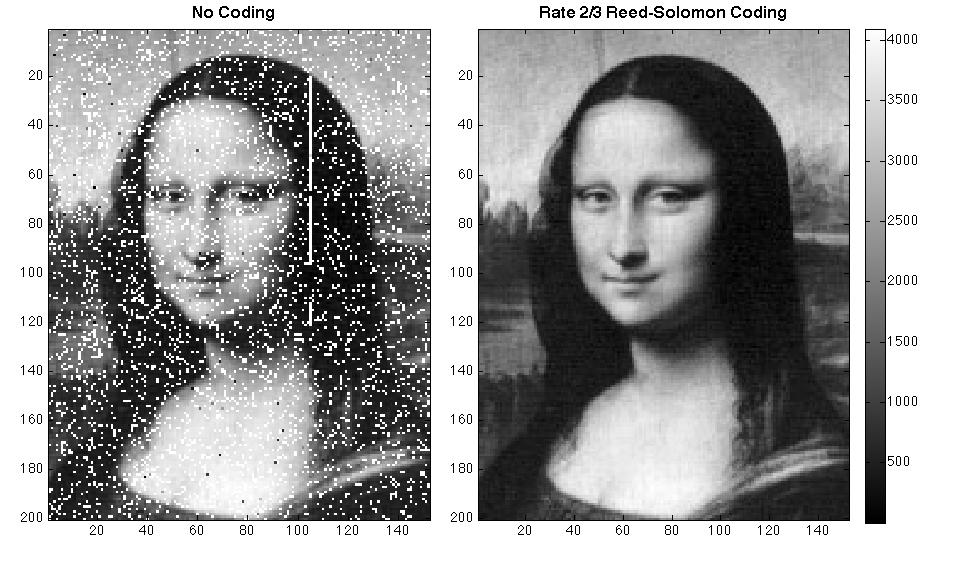
Reed-Solomon codes correct burst errors in data transmission and storage
Error detection and correction
Reed-Solomon codes correct burst errors in data transmission and storage
Reed-Solomon codes are a type of error correction code that can detect and correct multiple symbol errors in data transmission and storage. They are particularly effective at correcting burst errors, which are sequences of errors that occur in clusters.
Example
In a Reed-Solomon code with parameters (255, 223), up to 16 symbols can be corrected, enabling the correction of burst errors that affect up to 16 consecutive data symbols.
Remember this
Reed-Solomon codes are crucial for maintaining data integrity in communication systems and storage devices, ensuring reliable data transfer and recovery.
Text adapted from Wikipedia, licensed under CC BY-SA 4.0.
Related concepts
Cyclic redundancy check
How do we know if a message is corrupted during transmission?
Low-density parity-check code
LDPC codes revolutionized coding theory with significant performance improvements
Error correction code
Turbo codes achieve near-Shannon-limit error correction with iterative decoding
Shannon's source coding theorem: you can't compress below entropy
Can you squeeze endless text into fewer bits without losing anything?
TCP vs UDP: TCP guarantees delivery order, UDP is faster but unreliable
TCP guarantees delivery order, UDP is faster but unreliable
a parity check bit does: detects single-bit errors by making total 1s even/odd
Can you spot a single mistake in a secret code?
Swipe through 100 ML concepts daily
Open Pocket Polymath