Dickinson's dashes fracture syntax to mirror the fluidity of thought
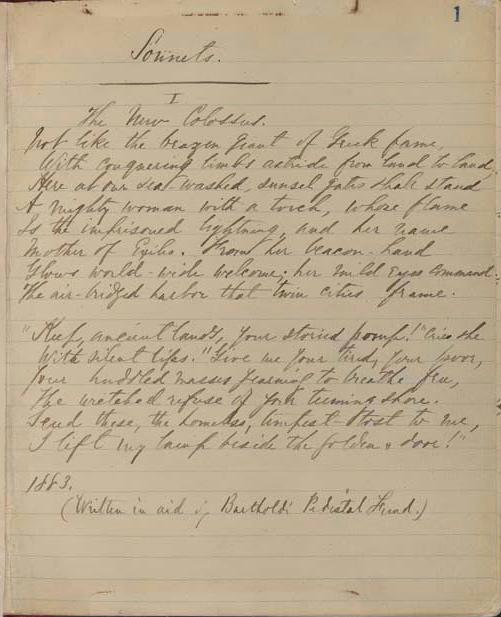
Image: Emma Lazarus (1883 manuscript), Public domain, via Wikimedia Commons
Dickinson's dashes do
Dickinson's dashes fracture syntax to mirror the fluidity of thought
Imagine reading a complex poem and feeling overwhelmed by the dense structure. You crave a more natural flow that reflects how thoughts actually unfold.
Dickinson's dashes break up the poem's rhythm, mimicking the unpredictable way our thoughts jump from one idea to another. This technique allows readers to experience the poem as if they're following the poet's thought process in real-time.
Example
In a poem, the sentence "Life is but a dream" might appear as "Life is-but-a-dream," with dashes creating a pause that mirrors the sudden realization of life's fleeting nature.
Remember this
Dickinson's dashes create a rhythm that mirrors the natural flow of thoughts, enhancing the reader's connection to the poem's emotional and intellectual landscape.
Text adapted from Wikipedia, licensed under CC BY-SA 4.0.
Related concepts
New Criticism
New Criticism focused on the poem as an autonomous object
Existence of God
Can words mean the same thing every time?
Cubism
Cubism shatters Renaissance single-point perspective by depicting subjects from multiple viewpoints
Rimbaud's 'systematic derangement of all the senses' sought
Rimbaud's 'systematic derangement of all the senses' sought a new poetic language through extremity
Dialectical materialism
How does our mind evolve to understand the world better?
The Da Vinci Code (film)
Fibonacci sequence uncovers hidden patterns in nature
Swipe through 100 ML concepts daily
Open Pocket Polymath