Did light behave like waves or particles? Imagine trying to understand a mysterious shadow
Image: Andrey Chernogorodov, CC BY 4.0, via Wikimedia Commons
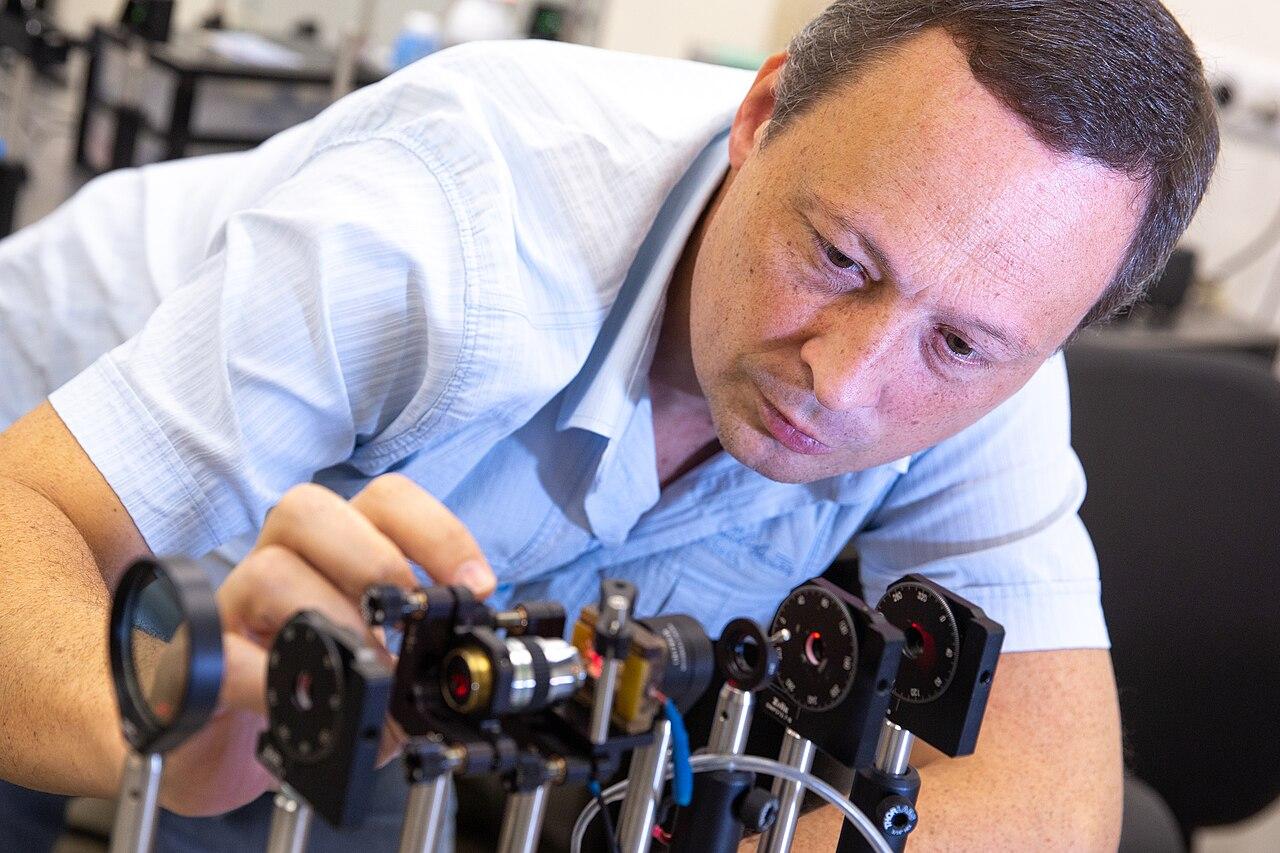
Davisson–Germer experiment
Did light behave like waves or particles? Imagine trying to understand a mysterious shadow
You're walking in a forest at dusk, and you see a shadow flicker on the ground. It's hard to tell if it's just your eyes playing tricks or something moving.
Light can act like waves, spreading out and bending, or like particles, bouncing off things. This idea helps explain why the shadow flickers.
Example
As you step closer, the shadow's edges blur, showing light spreading out like waves.
Remember this
Light's wave-particle duality explains its mysterious behaviors, like flickering shadows.
Text adapted from Wikipedia, licensed under CC BY-SA 4.0.
Related concepts
Erwin Schrödinger
Can light be both a wave and a particle?
History of physics
Did Dirac's math hint at a shadowy twin of electrons?
Stern–Gerlach experiment
Stern-Gerlach experiment showed quantized angular momentum
Copenhagen interpretation
Wavefunction collapse is fundamental
Dirac equation
Dirac equation implies existence of antimatter
Einstein's photoelectric explanation used Planck's E=hf to predict that higher frequency light ejects faster electrons
Why can't you just turn up the brightness to get electrons flying?
Swipe through 100 ML concepts daily
Open Pocket Polymath