Proofs are programs, types are propositions
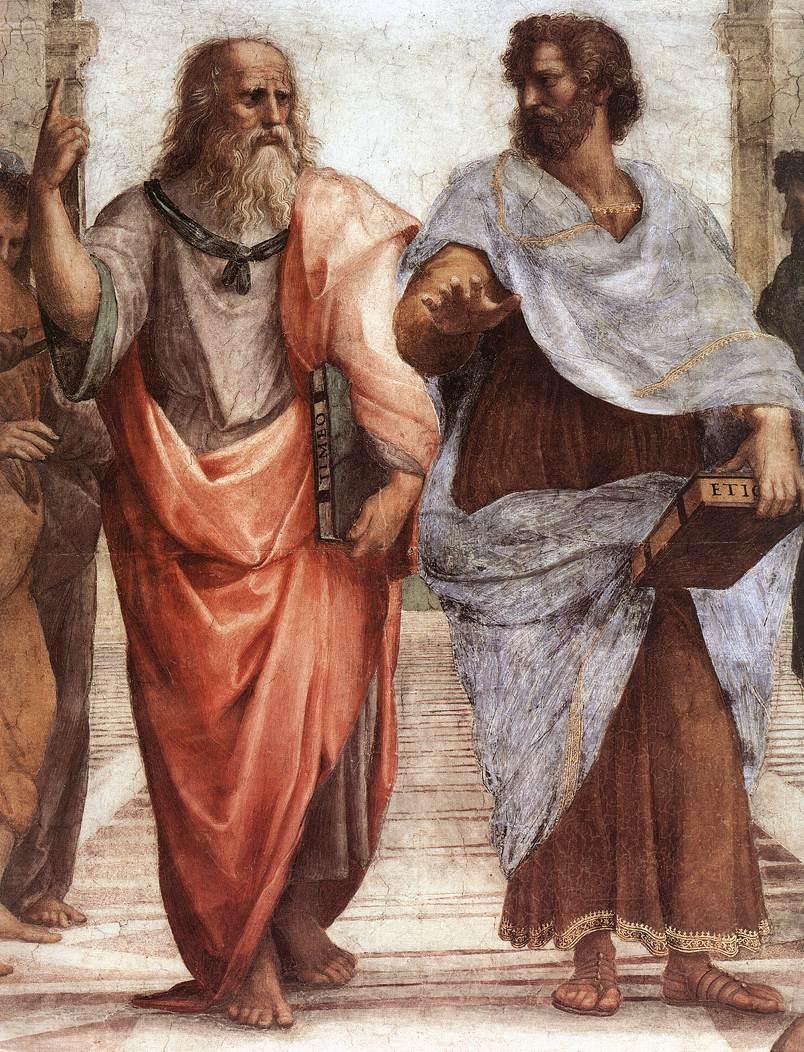
Image: Raphael, Public domain, via Wikimedia Commons
Curry–Howard correspondence
Proofs are programs, types are propositions
The Curry-Howard correspondence establishes a direct relationship between computer programs and mathematical proofs. This means that writing a computer program is akin to constructing a mathematical proof, and conversely, proving a theorem is like writing a computer program. This correspondence provides a framework for understanding how logical deductions and computational processes are fundamentally connected.
Example
Consider a simple function in Haskell, such as `id :: a -> a`, which returns its input. This function can be seen as a proof of the proposition that for any type `a`, applying `id` to `a` yields `a`. In this case, the Haskell function `id` serves as the "program" that corresponds to the "proof" of the proposition.
Remember this
Understanding the Curry-Howard correspondence is crucial for fields like programming language theory and proof theory, as it bridges the gap between logical reasoning and computational execution.
Text adapted from Wikipedia, licensed under CC BY-SA 4.0.
Related concepts
Dependent type
Dependent types depend on values, not just types
Monad (functional programming)
Monads are a type constructor with two operations: return and bind
P
P vs NP asks if every problem whose solution is quickly verifiable can also be quickly solved
the union bound says: P(A∪B) ≤ P(A) + P(B)
The union bound states: P(A∪B) ≤ P(A) + P(B)
Yoneda lemma
The Yoneda lemma embeds a locally small category into a functor category
constitutional AI does: model critiques and revises its own outputs using principles
Constitutional AI critiques and revises outputs using principles
Swipe through 100 ML concepts daily
Open Pocket Polymath