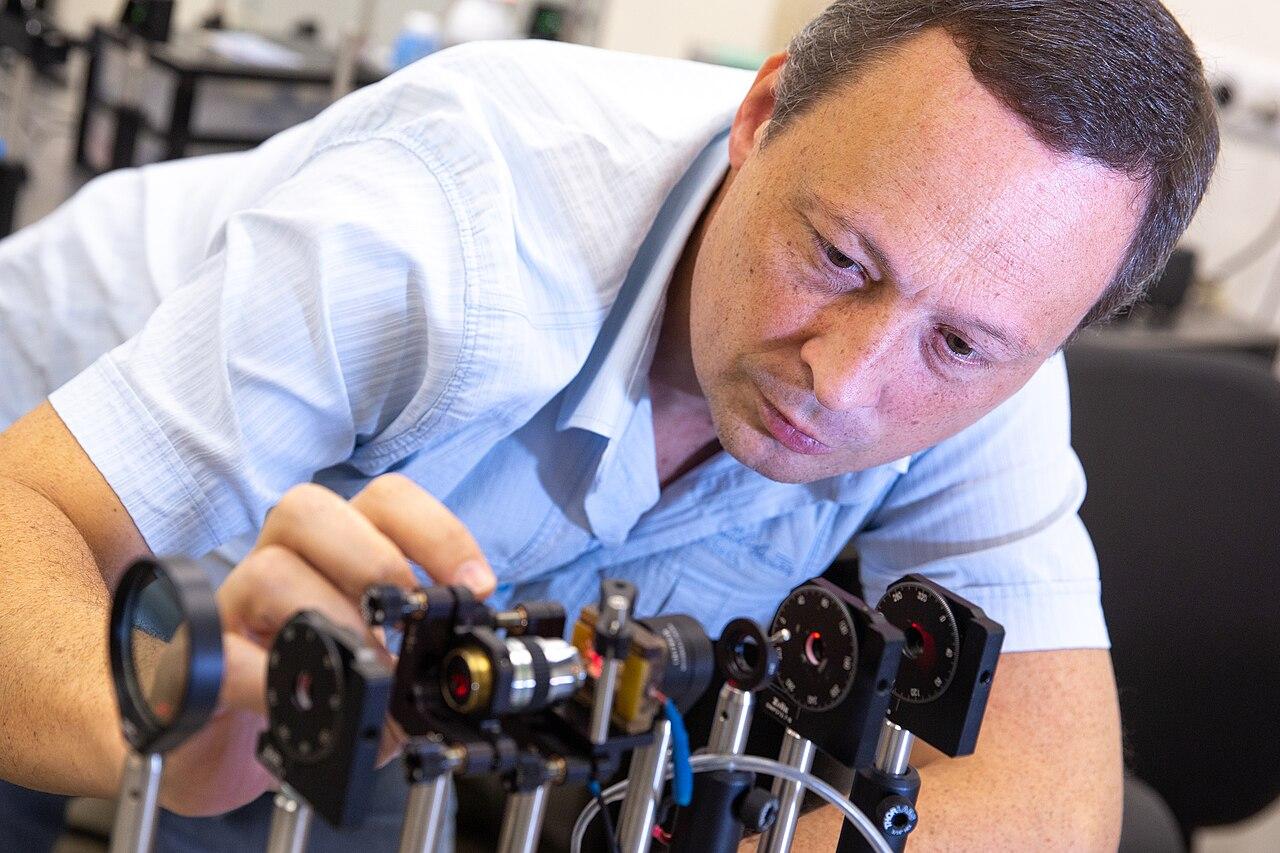
Bose-Einstein condensation occurs at ultralow temperatures
Image: Andrey Chernogorodov, CC BY 4.0, via Wikimedia Commons
Bose–Einstein condensation of quasiparticles
Bose-Einstein condensation occurs at ultralow temperatures
Bose-Einstein condensation (BEC) is a phase transition that happens when particles, such as atoms or quasiparticles, are cooled to temperatures near absolute zero. At these ultralow temperatures, particles occupy the same quantum state, leading to macroscopic quantum coherence.
Quasiparticles, which are collective excitations in materials, can also undergo Bose-Einstein condensation. These particles, including those with integer spins, behave similarly to traditional particles and can be expected to obey Bose-Einstein statistics. This phenomenon has been both predicted and observed in various quasiparticles.
The study of Bose-Einstein condensation continues to be an active field of research. Scientists are exploring the conditions for condensation of different quasiparticles, which can lead to new insights and applications in materials science and quantum physics.
Remember this
Understanding Bose-Einstein condensation helps us explore new states of matter and could lead to technological advancements in quantum computing and other fields.
Text adapted from Wikipedia, licensed under CC BY-SA 4.0.
Related concepts
Bose–Einstein condensate
Bosons collapse into the same quantum state at near absolute zero
Quantum decoherence
Quantum decoherence explains wavefunction collapse through environmental interaction
universality means in phase transitions
Why do ice cubes vanish in a glass of water?
Pauli exclusion principle
Why can't two electrons crash into the same spot?
Copenhagen interpretation
Wavefunction collapse is fundamental
Measurement in quantum mechanics
Quantum states describe probabilities, not certainties
Swipe through 100 ML concepts daily
Open Pocket Polymath