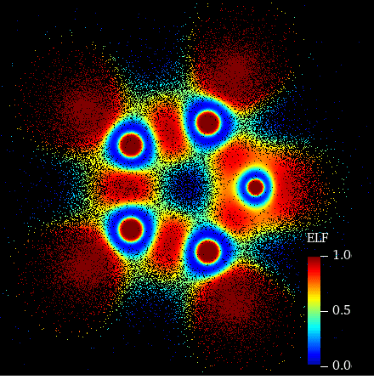
Why can't we just treat everything in a molecule as moving together?
Image: Silvi, CC BY-SA 4.0, via Wikimedia Commons
Born–Oppenheimer approximation
Why can't we just treat everything in a molecule as moving together?
Imagine you're at a crowded concert, trying to dance with friends. Everyone's moving differently, but you focus on your friends' movements, ignoring the crowd's chaos.
In a molecule, electrons and nuclei move differently because they're like dancers with different weights. The Hartree-Fock approximation helps us focus on each "dancer" separately, simplifying the complex dance.
Example
At the concert, you and your friend (electrons) dance freely while ignoring the crowd (nuclei) for a moment to enjoy the music together.
Remember this
The Hartree-Fock approximation simplifies the complex interaction between electrons and nuclei in a molecule, allowing us to study them separately.
Text adapted from Wikipedia, licensed under CC BY-SA 4.0.
Related concepts
Quantum decoherence
Quantum decoherence explains wavefunction collapse through environmental interaction
Renormalization
Ever wondered why your smartphone's battery drains faster in cold weather?
Symmetry in quantum mechanics
Can flipping time keep things spinning just right?
Electron configuration
Why can't two electrons in an atom be identical twins?
Electron
Ever wondered why some materials heat up quickly while others don't?
Erwin Schrödinger
Can light be both a wave and a particle?
Swipe through 100 ML concepts daily
Open Pocket Polymath