BCS theory explains superconductivity through Cooper pairs of electrons
BCS theory
BCS theory explains superconductivity through Cooper pairs of electrons
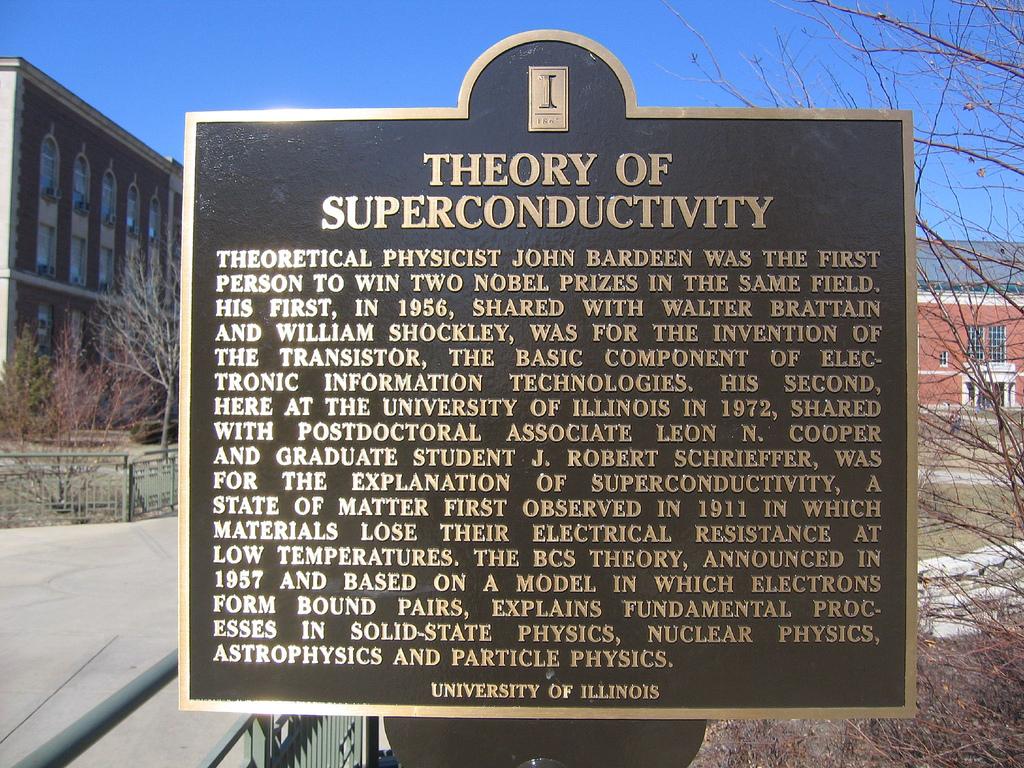
The BCS theory describes superconductivity as a microscopic effect caused by a condensation of pairs of electrons known as Cooper pairs. These pairs move through the lattice without resistance. The theory was proposed by John Bardeen, Leon Cooper, and John Robert Schrieffer in 1957.
Example
In conventional superconductors, BCS theory explains phenomena like the Meissner effect, where a material expels magnetic fields when cooled below its critical temperature.
Remember this
Understanding BCS theory is crucial for explaining and predicting the behavior of conventional superconductors.
Text adapted from Wikipedia, licensed under CC BY-SA 4.0.
Related concepts
Cooper pair
Cooper pairs are bound electrons with opposite spin and momentum
The Hunt for Gollum
Superconductors defy normal magnetic rules
Meissner effect
Did you know magnets can disappear in cold metal?
Symmetry in quantum mechanics
Can flipping time keep things spinning just right?
Supersymmetry
Every fermion has a bosonic partner and vice versa
Quantum Hall effect
Hall resistance Rxy is quantized in units of e²/h
Swipe through 100 ML concepts daily
Open Pocket Polymath